- 20+ cloud platforms, one dashboard
- AI-powered cost optimization (Claude)
- 99.99% uptime SLA
One Platform. Every Cloud Provider.
The internet was never meant to run on a single cloud. Yet modern infrastructure has become fragmented across providers, regions, edge networks, AI platforms, and deployment systems — forcing engineering teams to navigate rising complexity, escalating costs, and increasing operational risk.
AW3 changes that.
Built by AW3 Technology, AW3 is an AI-native multi-cloud orchestration platform designed to unify the modern internet into a single intelligent control plane. It enables organizations to deploy, manage, optimize, and route workloads across 20+ cloud providers from one unified system — without vendor lock-in.
AWS. Google Cloud. Azure. Vercel. Cloudflare. Railway. Kubernetes. GPU providers. Edge networks. All connected through one intelligent operational layer.
Infrastructure That Thinks for Itself
At the heart of AW3 is an orchestration engine powered by artificial intelligence. Rather than forcing teams to manually optimize infrastructure decisions, AW3 continuously analyzes performance, latency, regional demand, cost structures, platform capabilities, and workload behavior in real time.
The platform intelligently determines where applications should run, how traffic should route, when workloads should fail over, and how infrastructure can become faster, cheaper, and more resilient — automatically.
Infrastructure becomes adaptive. Dynamic. Self-optimizing.
Instead of static deployments tied to one provider, AW3 transforms cloud infrastructure into a living network that continuously rebalances itself around business priorities — whether optimizing for cost, performance, redundancy, geographic proximity, or AI compute availability.
The Operating System for Multi-Cloud Infrastructure
AW3 was designed for the emerging reality that no single provider can serve every workload optimally. Different platforms excel at different things: edge routing, GPU inference, static hosting, databases, serverless execution, high-frequency compute, global latency.
AW3 abstracts that complexity away. Teams can deploy applications, APIs, AI models, edge services, and full-stack workloads across providers using one dashboard, one API, and one orchestration layer.
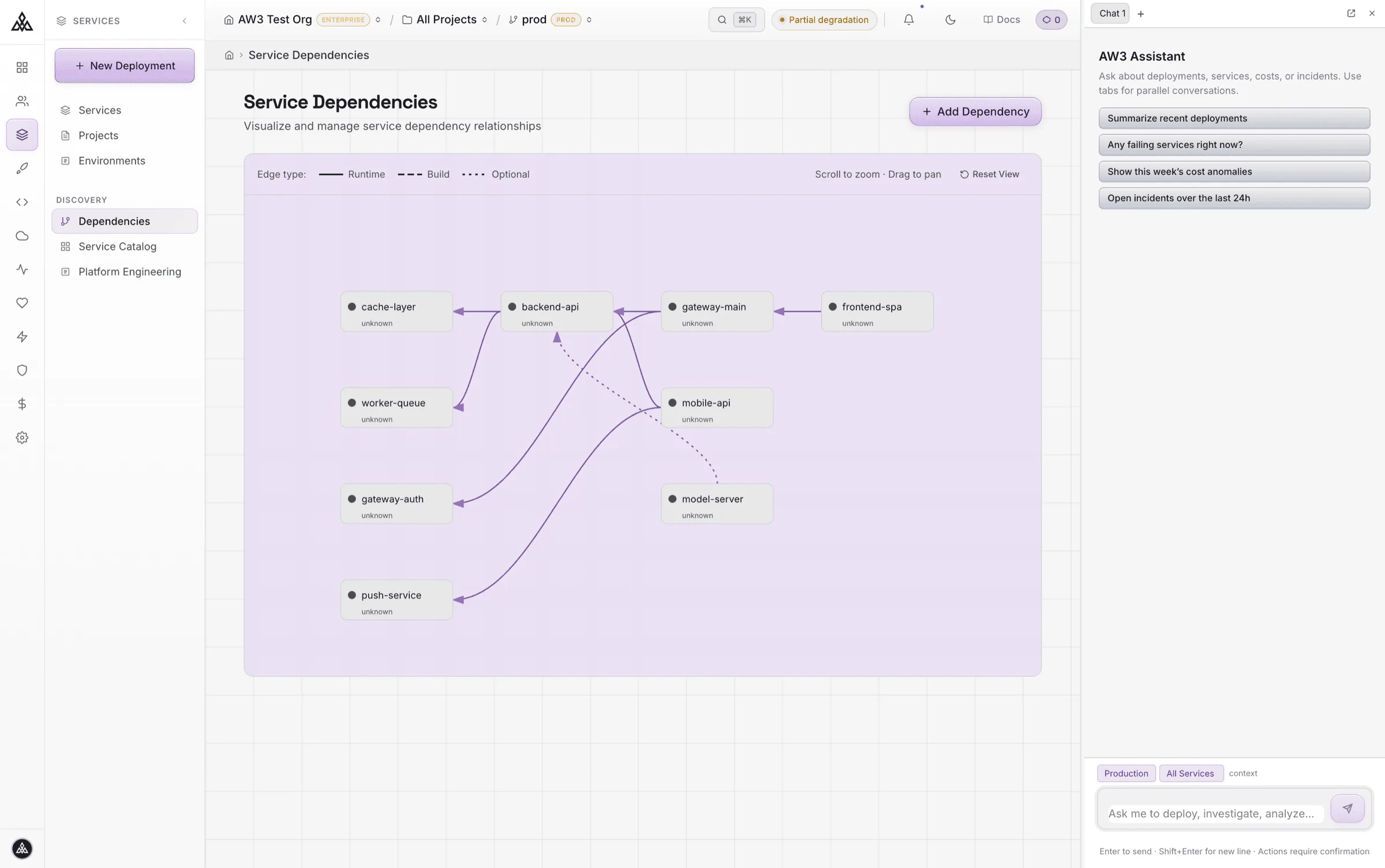
Blue/green deployments, canary rollouts, failover routing, geo-resolution, traffic weighting, secrets management, GitOps, observability, and compliance workflows all operate inside a single unified system. Infrastructure becomes programmable at the network level itself.
AI-Native Infrastructure Management
AW3 isn't simply a dashboard for cloud providers. It's an intelligent operational layer built for the age of AI-native infrastructure.
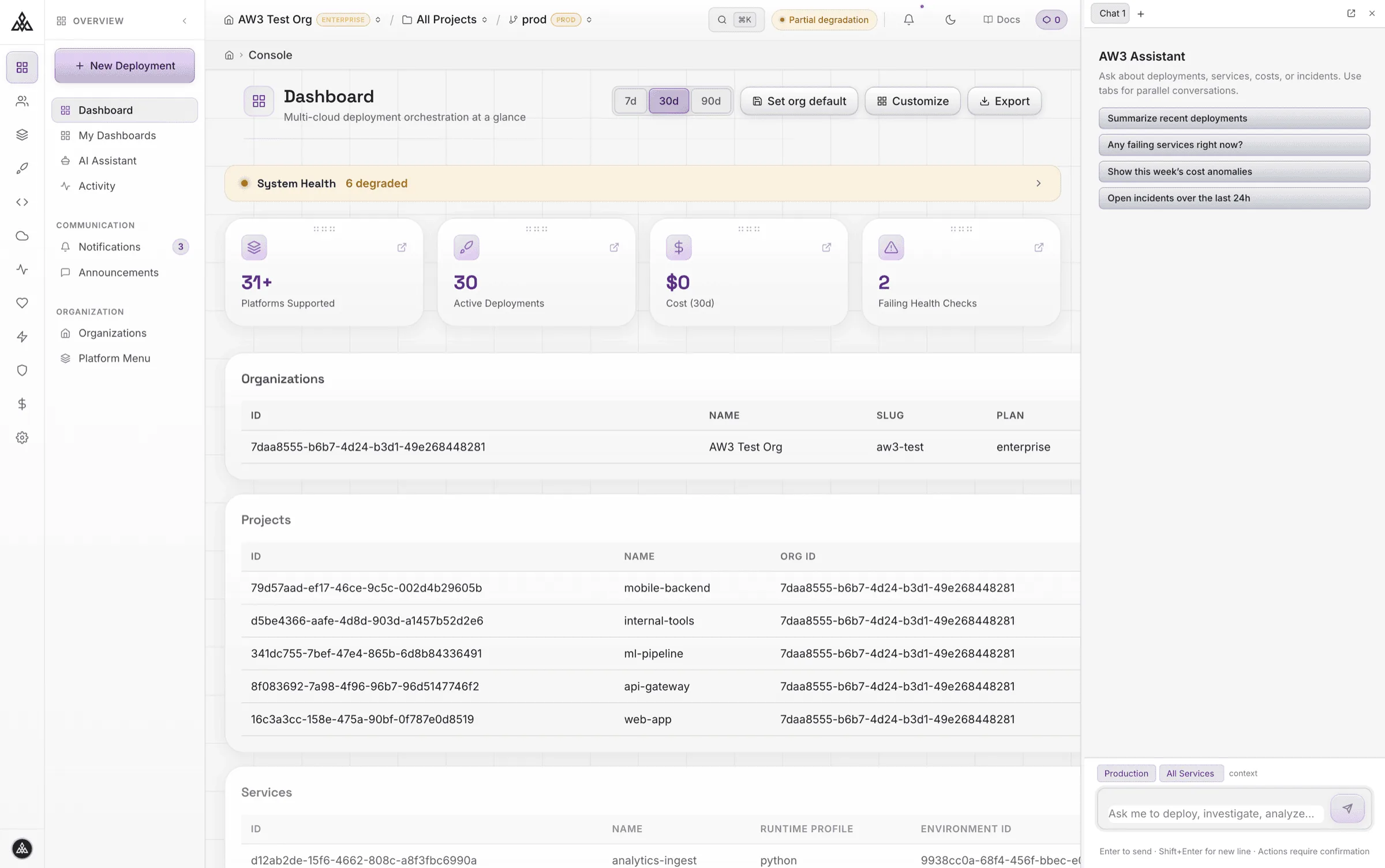
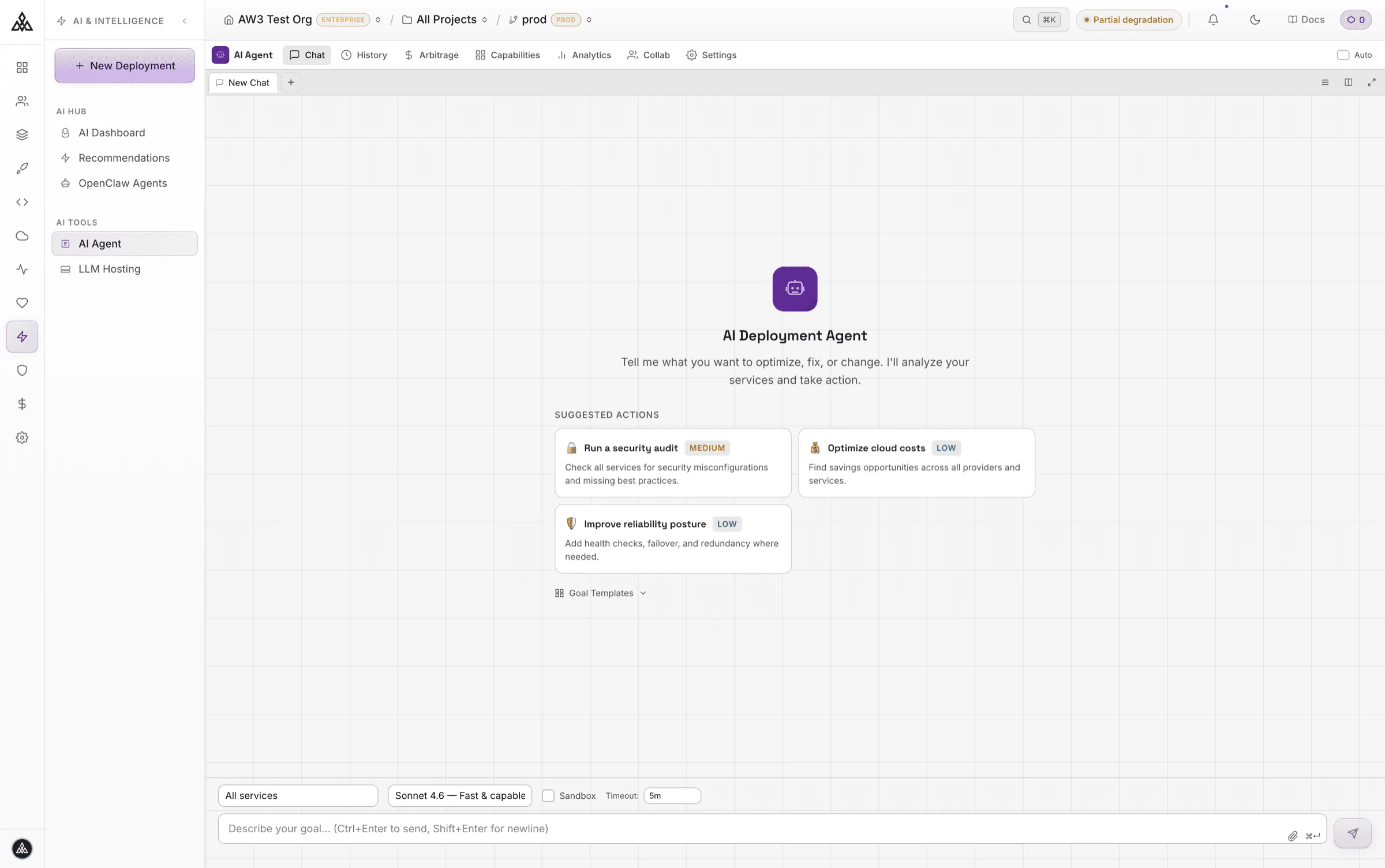
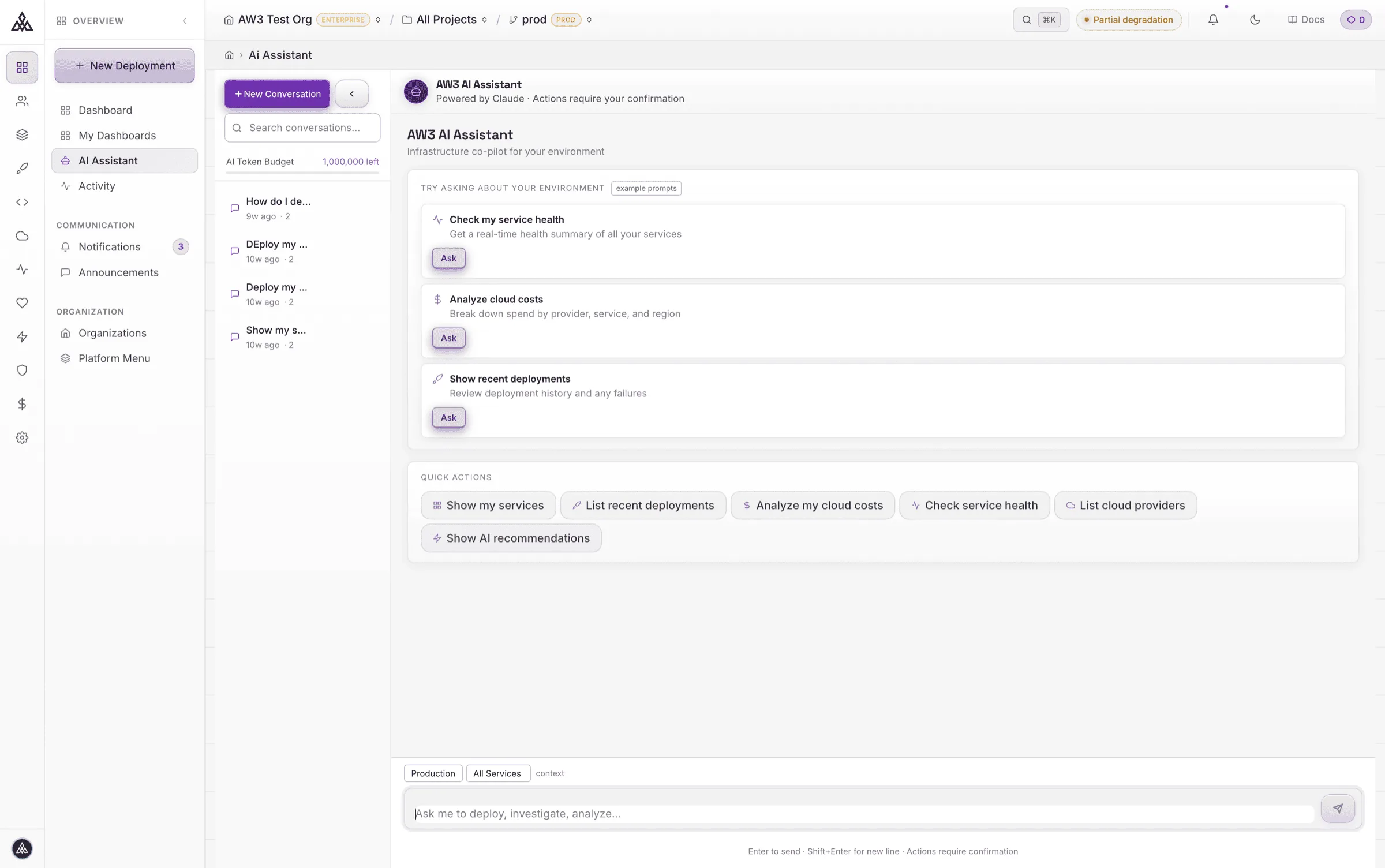
Its Claude-powered assistant allows teams to deploy and manage infrastructure through natural language — turning complex cloud operations into simple intent-based workflows.
"Deploy my API globally with low-latency routing."
"Reduce infrastructure spend by 30%."
"Fail over traffic from AWS to Cloudflare if latency spikes."
The system interprets operational intent, generates deployment strategies, and executes them automatically across the infrastructure stack. This marks a shift from manual DevOps toward autonomous orchestration.
How It Works
- Connect. Link every hosting platform, from AWS, GCP, Azure, Vercel, Cloudflare and Fly.io to Kubernetes and GPU clouds, into one control plane.
- Set what matters. Tell AW3 whether to optimize for performance, cost or capability, and define policies: region-lock, budget caps, deploy windows and approval gates.
- Deploy and route. Ship with Standard, Blue/Green or Canary strategies, or just say "deploy my API to production on AWS." Traffic is routed to the best target in real time.
- Monitor and optimize. Watch real-time health maps and p50/p95/p99 latency, sync daily cost from every provider, and apply Claude's savings recommendations with one click.
Features
- AI-powered cost optimization: Claude analyzes cross-provider cost and performance to surface cheaper alternatives and idle resources; apply or dismiss each in one click
- Performance orchestration: traffic auto-routes to the fastest platform by location, latency and load, with p50/p95/p99 monitoring per service
- Automatic failover: health checks every 60 seconds, with traffic rerouted to healthy alternatives when a platform degrades
- Smart geo-routing: users go to the nearest, fastest platform with real-time best-target resolution
- Unified security: AES-256-GCM encrypted secrets, environment-scoped stores, MFA, SSO/SAML 2.0 and SCIM provisioning
- CLI, SDK and API: a full CLI, TypeScript SDK and REST API, including natural-language deploys via
aw3 intent - Policy engine: region-lock, provider-whitelist, budget-cap, deploy-window, approval-required, test-coverage and vulnerability-scan policies
Deployment and traffic
- Strategies: Standard, Blue/Green with promote, Canary (5% to 100% ramp), and instant rollback
- Lifecycle: exponential-backoff retry, live SSE log streaming, secret diff before deploy, and approval gates with comments
- Routing modes: Weighted, Blue/Green, Canary ramp, Geo, Failover and Smart Resolve
Everything Needed to Run at Scale
- Cost management: daily cost sync from all providers, drill-down by provider, service, environment and region, and multi-threshold budget alerts via Slack and PagerDuty
- Health checks and monitoring: HTTP, TCP and synthetic probes, with real-time health maps, uptime history and latency metrics
- AI assistant and natural-language deploys: in-dashboard Claude chat to diagnose deployments, explore the platform or deploy in plain English
- Access control and teams: Owner, Admin, Member and Viewer roles, MFA, SSO/SAML/OIDC, SCIM, a permission matrix, and break-glass access with a full audit trail
- Compliance and audit: full audit logging with CSV export, SOC 2 readiness, CIS benchmarks, per-deployment SBOM with vulnerability scanning, data residency and GDPR support
- Secrets management: environment-scoped stores with AES-256-GCM at rest, in-memory decryption at deploy time, and keys diffed before deployment
- LLM and AI hosting: GPU-backed inference on CoreWeave, RunPod and Modal with VRAM estimation, A/B endpoints, batch inference and a HuggingFace model registry
- DORA metrics and GitOps: deployment frequency, lead time, change-failure rate and MTTR, plus commit-driven reconciliation, drift detection and Terraform export
- FinOps and spot fleets: spot and preemptible fleet management with interruption handling, egress-aware cost arbitrage and carbon-aware scheduling
- Runtime security: eBPF runtime protection with Falco-compatible rules, ML anomaly detection, FIPS 140-2 mode, BYOK/KMS, and SigStore/Cosign signing
20+ Cloud Platforms
Connect every hosting platform and let AW3 choose the best one for each workload based on performance, pricing and capabilities.
- Cloud: AWS, Google Cloud, Azure, DigitalOcean, Kubernetes, Hetzner, Linode
- Frontend and edge: Vercel, Netlify, Cloudflare, Fly.io
- Full stack and backend: Railway, Render, Supabase
- GPU: CoreWeave (A100/H100), RunPod, Modal
Pricing
Start free and scale with usage, with no hidden fees. One credit equals one compute action; credit packs never expire and Pro credits roll over.
- Starter, free forever: 500 credits, 3 connected platforms, 5 projects, community support, basic analytics and 7-day log retention
- Pro, $29/month: 10,000 credits a month with rollover, unlimited platforms and projects, priority support, advanced analytics, 30-day log retention, custom domains and 5 team seats
- Enterprise, custom: unlimited credits and seats, a 99.99% uptime SLA, dedicated support, 90-day log retention, SSO/SAML, custom contracts and SOC 2 compliance
FAQs
What are credits used for? Credits are consumed by hosting usage: deployments, bandwidth and compute time. Different actions consume different amounts, and one credit equals one compute action.
Do unused credits expire? On Pro, unused credits roll over to the next month. Free-tier credits reset monthly. Purchased credit packs never expire.
What happens if credits run out? AW3 sends a notice when the balance runs low, and a credit pack or upgrade is available at any time. Live deployments are never terminated for a low balance.
Built for the Future of the Internet
Modern applications are becoming increasingly distributed: AI workloads require GPUs, consumer apps require edge performance, global systems require geographic redundancy, regulated industries require data sovereignty. No single platform solves all of it.
AW3 was built to unify that fragmented future. From startups deploying their first global product to enterprises managing massive multi-region architectures, AW3 gives organizations the ability to operate infrastructure as a fluid, intelligent network rather than a collection of isolated cloud accounts.
The result is faster deployments. Lower costs. Higher resilience. And infrastructure that evolves continuously alongside the applications it powers.
The Future of Cloud Computing
Cloud computing began with virtualization. Then came containers. Then serverless.
AW3 represents the next evolution: cloud orchestration at planetary scale. A world where infrastructure decisions are no longer manual. Where applications dynamically move between providers. Where AI continuously optimizes the internet itself. Where developers define intent — and intelligent systems handle the complexity beneath it.
AW3 is more than a deployment platform. It's the beginning of autonomous infrastructure.
Status and Stack
Status: live in public beta at aw3.host, the hosting arm of AW3 Technology
Stack: TypeScript, Next.js, Node.js, a full CLI, REST API, and Claude