- Highlights, summary, chat, fact-check and quiz from one URL
- Web-grounded fact-checking with graded verdicts and real citations
- REST API, TypeScript and Python SDKs, and a 19-tool MCP server
Nobody has 40 minutes.
A 43-minute podcast might hold six useful minutes, and there is no way to know which six without watching all 43. So people scrub the timeline, skip by chapter, run it at 4x, or give up. QuickTube turns any YouTube video into highlights, a summary, a fact-check and a conversation you can actually have with it.
Paste a link. That is the whole onboarding — no extension, no account to connect, no upload.
Highlights
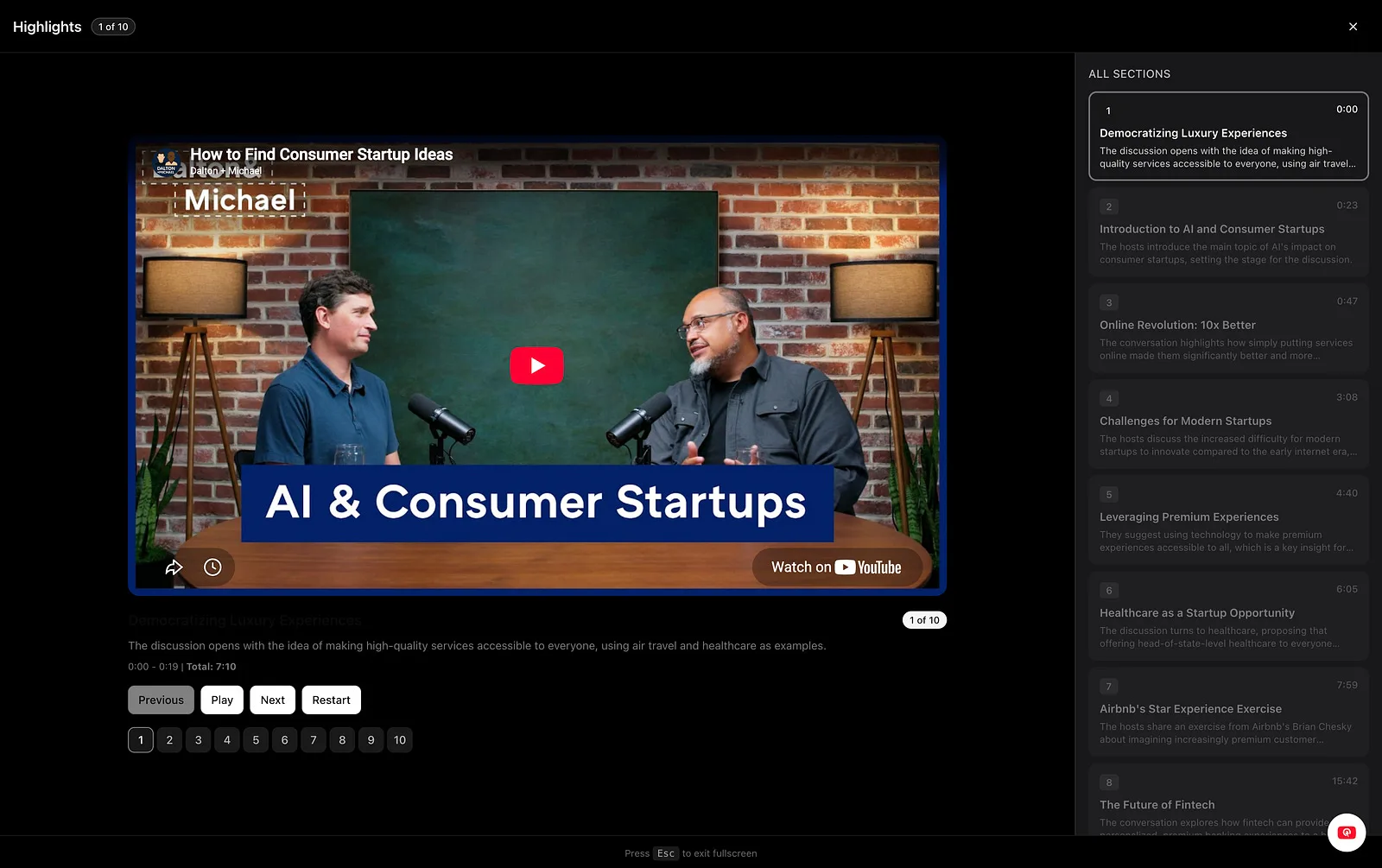
QuickTube finds the substantive moments in the transcript and sequences them into a condensed director's cut — a long conversation reduced to ten highlights running seven minutes and ten seconds, each with its own title and a one-line description of what happens in it. There is a fullscreen mode with every section listed down the side, and the compiled video can be downloaded.
Summary
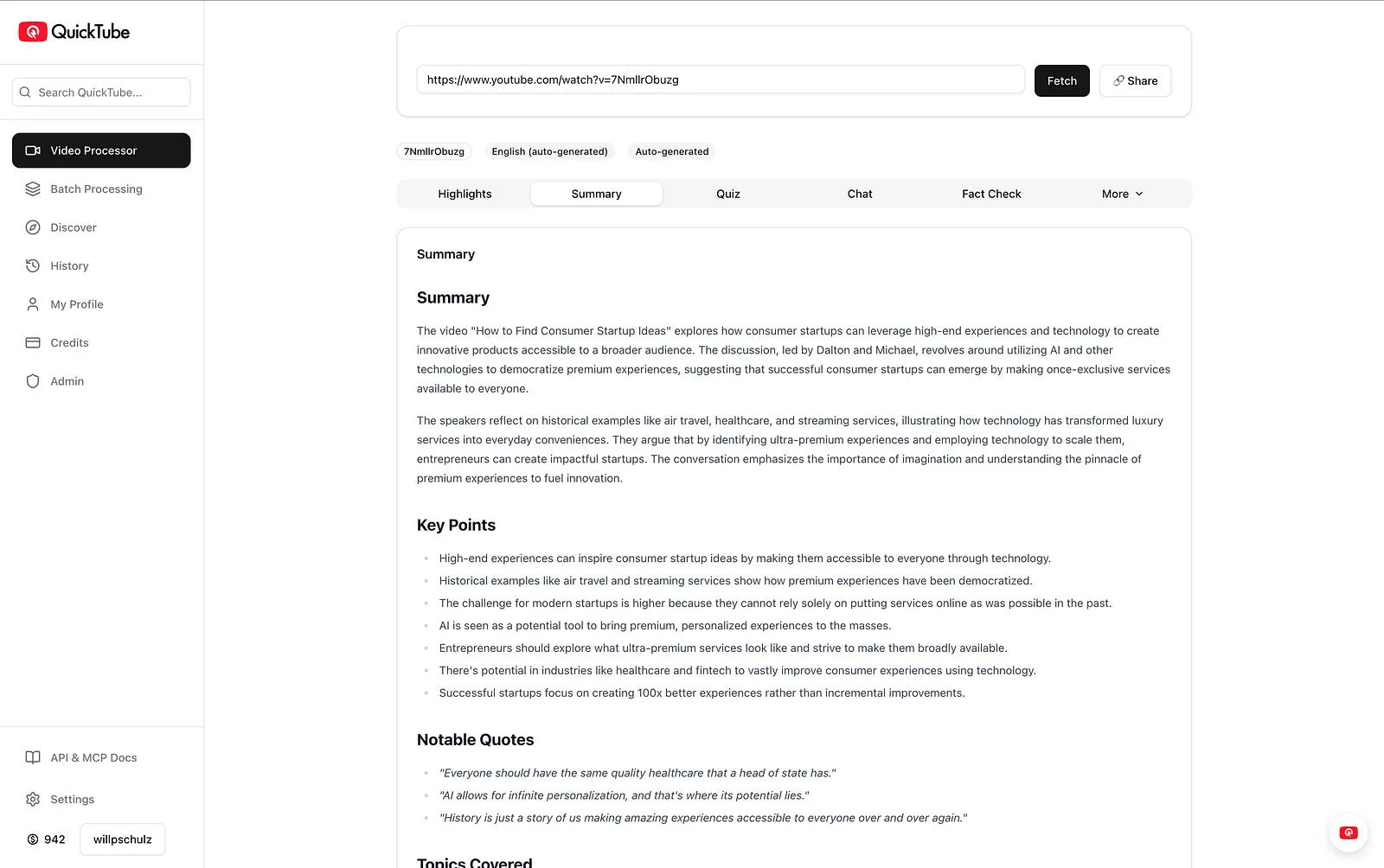
A structured read rather than a paragraph: prose summary, key points, notable quotes kept verbatim, and the topics covered. Text-to-speech will read it to you if you would rather listen.
Chat, and character mode
Ask questions and get answers grounded in the transcript rather than in the model's memory. Character mode goes further: QuickTube detects the individual speakers, builds a profile of each from how they actually talk and what they actually argued, and lets you talk to them separately.
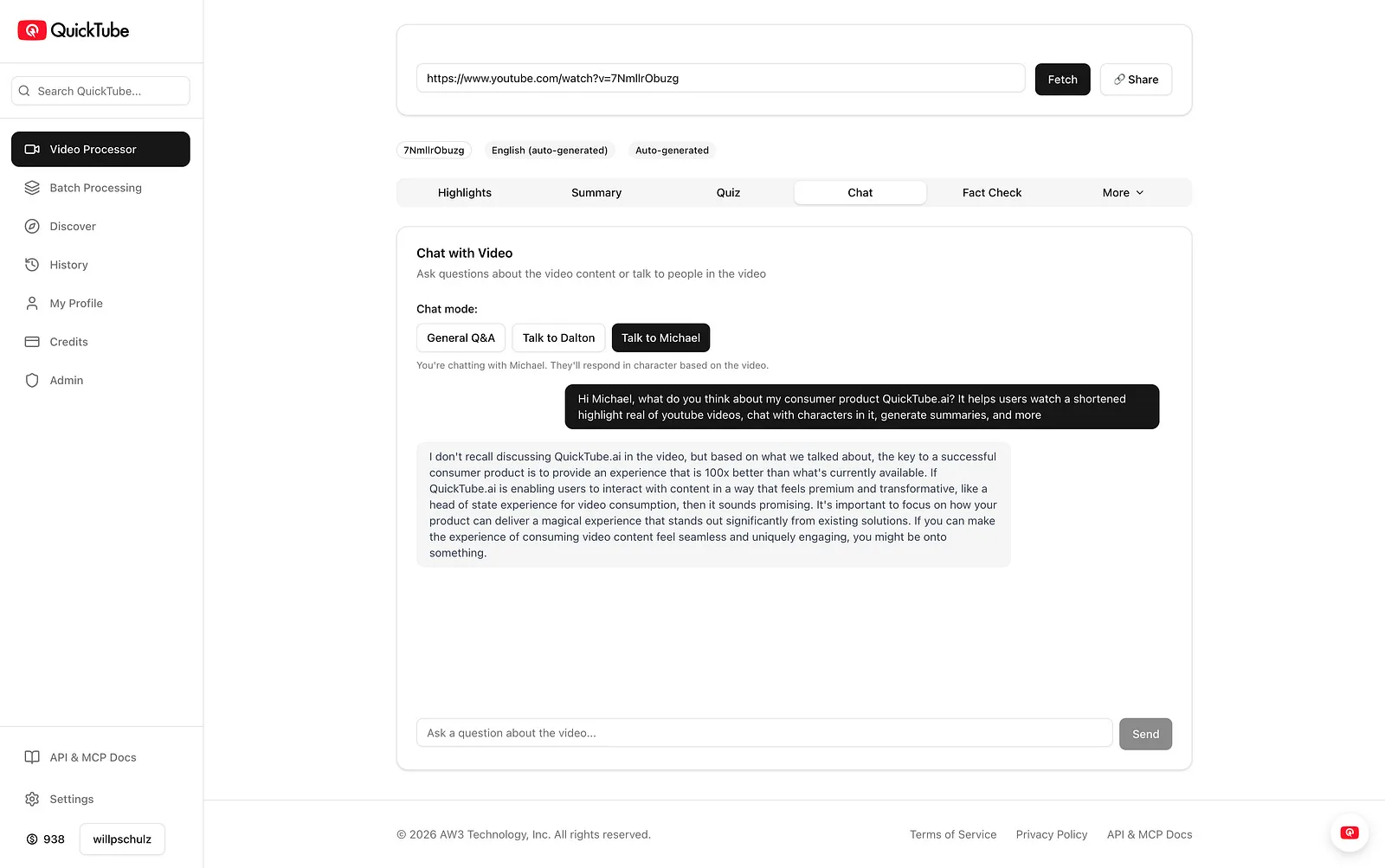
It also stays honest about the edges of what it knows, which matters more than sounding confident.
Fact check
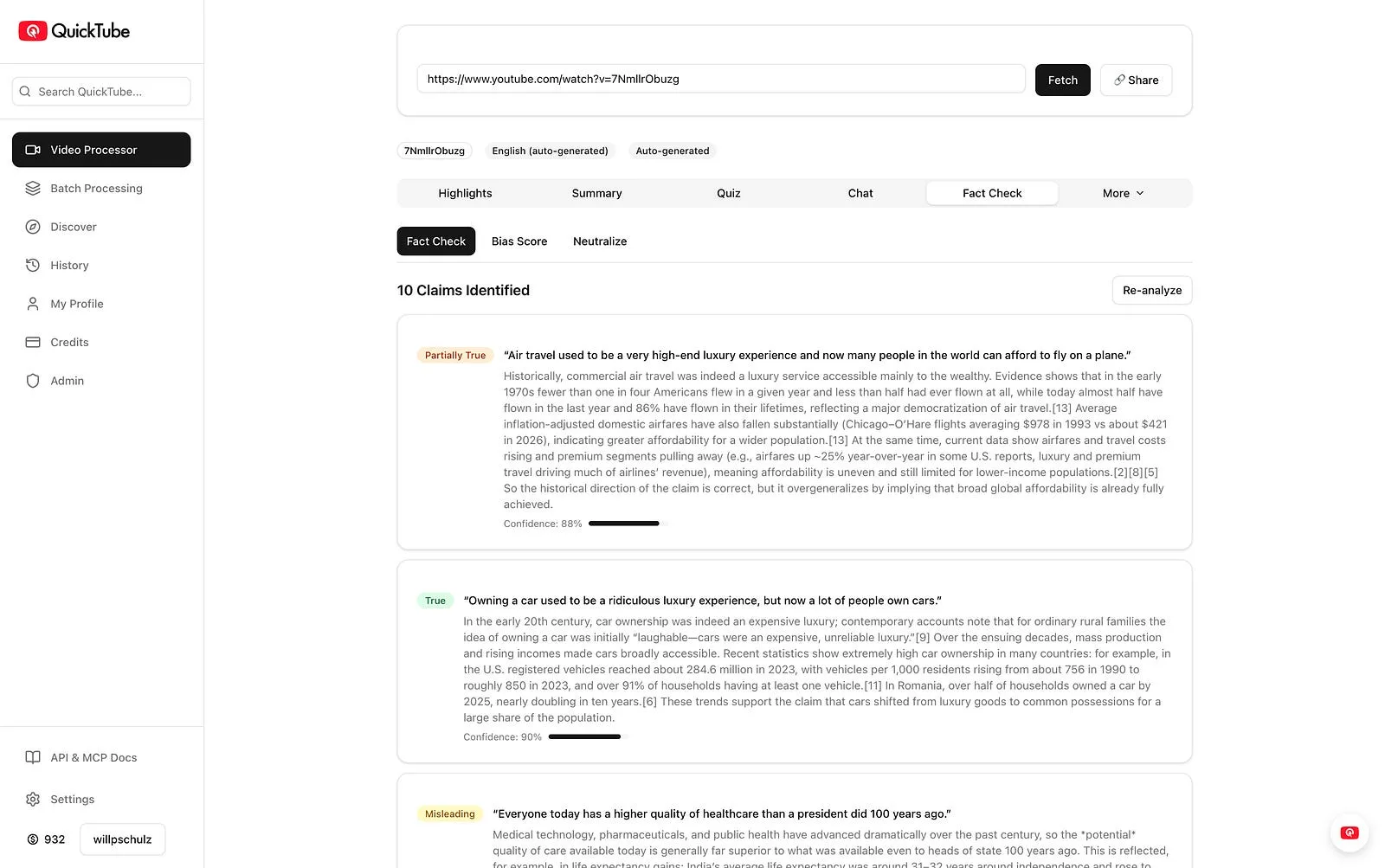
QuickTube pulls the checkable claims out of a video and tests them against live web sources, not model recall. Each claim gets a graded verdict — true, partially true, or misleading — with written evidence, numbered citations and a confidence score. A bias score reads the ideological lean of the framing, and Neutralize rewrites loaded language into something plainer.
The rest of it
- Quiz — comprehension questions generated from the video, for learners and for educators working from lecture recordings
- Batch — up to 20 URLs in one request with streaming progress, for a channel catalogue, a conference playlist or a competitor's uploads
- Discover — public profiles, followable users and a browsable feed of publicly analysed videos
- History — searchable sessions with soft delete, restore and PDF export
- Share — any analysis becomes a permanent public link with view analytics
Built to be driven by machines
A REST API with scoped keys (read, ai, sessions:read, sessions:write, billing:read) and interactive Swagger docs, a TypeScript SDK (npm install @quicktube/sdk), a Python SDK with sync and async clients (pip install quicktube), and an MCP server exposing 19 tools to any MCP-compatible agent (pip install quicktube-mcp).
Under the hood
Next.js 16, TypeScript, Tailwind and shadcn/ui on the front; FastAPI and async Python on PostgreSQL behind it. The GPT-4o family handles summarisation, highlights, quizzes and character chat; Perplexity's sonar-pro does the web-grounded fact-checking so citations are real. yt-dlp and server-side FFmpeg compile the highlight reels. Sessions use HttpOnly cookies with TOTP multi-factor and OAuth, and results stream as they are generated. GDPR data export, account deletion with a cancellation window and cookie consent are built in.
QuickTube is live at quicktube.ai. Signing up gets you 400 credits — enough for the longest video currently sitting unwatched in your Watch Later.