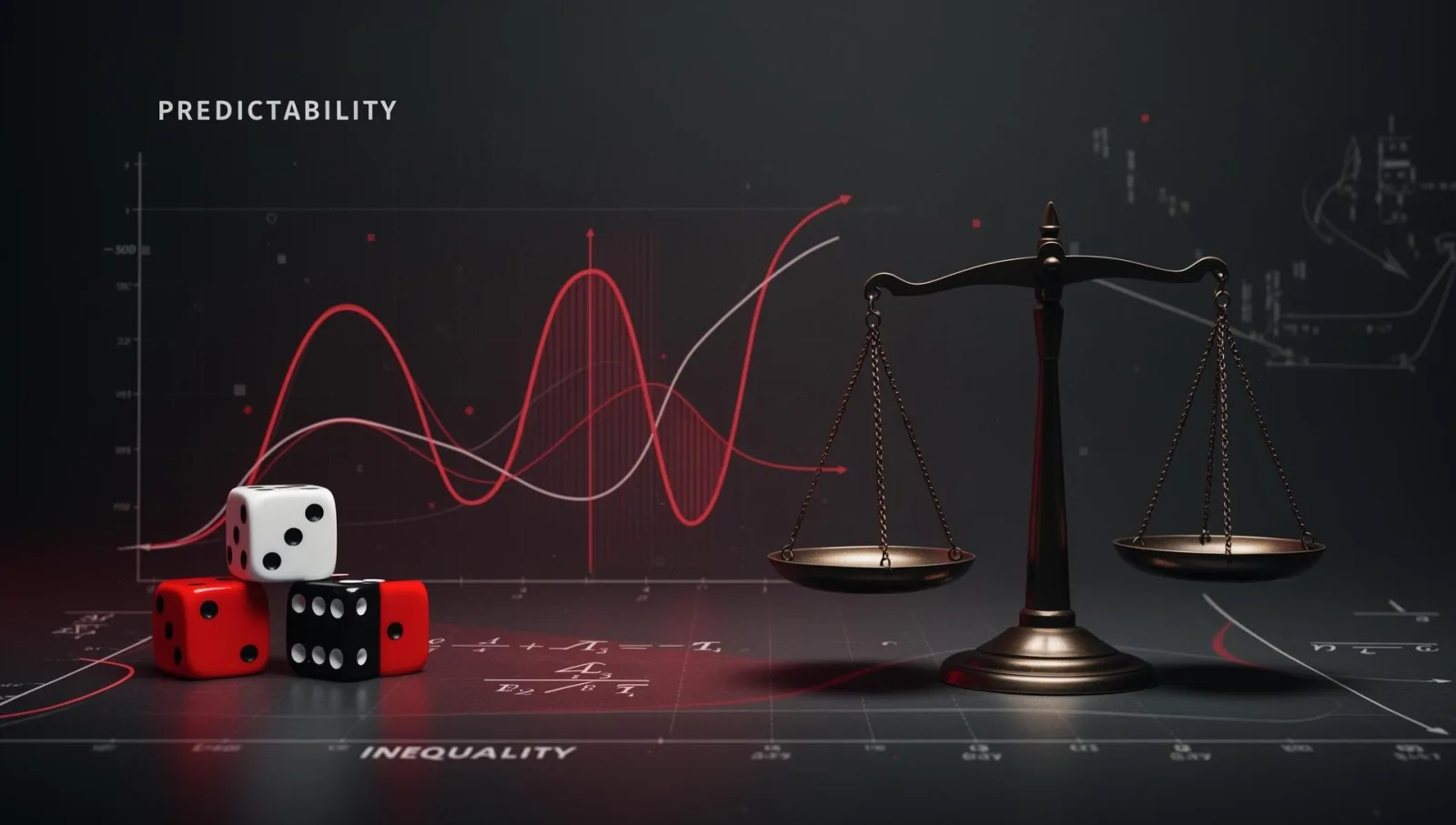
Predictability & Inequality
A quiet assumption underwrites the way many societies, especially the United States, talk about wealth and opportunity: financial success is unpredictable. The story goes like this: the market is a great casino—complex, capricious, full of hidden levers and near misses—so outcomes must be accepted as the roll of the dice. Some people will win big; most will not; the difference is chalked up to “luck,” “timing,” or “the way the world works.” The appeal of this story is obvious. If success is fundamentally unpredictable, then the winners owe little explanation beyond daring to play; and the losers are consoled with the hope that their number might be called tomorrow. But this story is not harmless. It becomes one of the chief cultural technologies by which we stabilize inequality. If the world is unknowable and outcomes are lottery-like, then unfairness has no remedy; it belongs to the nature of things.
The inverse is just as important: the more predictable a system is, the less inequality people are willing to tolerate. Predictability raises expectations. If the path from study to employment is consistently legible, if the relationship between effort and reward is transparent, if the rules are enforced with even hands, then the public becomes less patient with yawning gaps in outcome. A predictable system invites reform by making cause and effect visible; an unpredictable system anesthetizes reform by making outcomes feel mystical.
This essay explores the relationship between predictability and inequality—how cultures of luck legitimize hierarchy, how structures that increase reliability reduce tolerance for gaps, and why the policy debate is, at bottom, a debate over how much randomness we choose to permit in the distribution of life chances.
I. The Casino as a Civic Metaphor
The United States is especially vulnerable to a casino ethos. Its frontier myths, its gold rushes, its venture capital—these are stories of discontinuous jumps: one strike, one deal, one hit song, one IPO. The aesthetics of American aspiration feature jackpots rather than annuities. The cultural script encourages us to admire those who “beat the odds,” and to map their charisma onto the odds themselves: if they did it, maybe I can too. Casinos run on precisely this psychology. The visible winners (bells, lights, photos on the wall) are used to obscure the invisible arithmetic (the house edge, the expected loss). The hope of being the exception is the oxygen that keeps the room buzzing.
In economic life, a similar dynamic operates. Celebrity wealth and outlier exits saturate attention—unicorn founders, billionaire investors, viral influencers. This spectacle does more than entertain; it offers an implicit defense of the status quo. If the distribution of outcomes is framed as a series of unpredictable jackpots, then extreme inequality becomes the collateral of possibility. To regulate away the peaks would be to suffocate the dream. The casino metaphor thus stabilizes hierarchy by converting structural constraints (access to education, health, capital, networks) into narratives of luck and personal daring.
But markets are not casinos. They are social machines with rules, inputs, and predictable dynamics—just not equally visible to everyone. When insiders treat markets as predictable (through superior information, insulation from downside, access to credit, legal sophistication) while outsiders treat them as luck, the resulting asymmetry is not a mystery of fate; it is a design that launders power through uncertainty.
II. Predictability and the Politics of Tolerable Gaps
People will tolerate outcome gaps if the process feels fair and if the path feels knowable. That is the psychology of a legitimate order. Two corollaries follow:
-
Opacity grows tolerance for inequality. When rules are complex, when the relationship between work and reward is noisy, when enforcement is selective, citizens lower their expectations and raise their tolerance for gaps. They explain the difference between their lives and the lives of elites as “luck” or “genius” instead of “structure.”
-
Reliability shrinks tolerance for inequality. When public services are dependable, when contracts are enforced, when education predictably lifts earnings, when healthcare predictably prevents ruin, people expect more convergence. The same gap that felt acceptable in chaos feels scandalous in order.
Predictability is not about guaranteeing identical outcomes. It is about compressing the noise between cause and effect so that responsibility can be assigned and reform can be rational. The more a society can say, “If you do X, Y will likely follow,” the more it can demand that institutions be judged by whether Y actually follows for everyone, not only for the well-connected.
III. The Mobility Mirage
A casino culture clings to the mobility story: in America, the child of a janitor can become a CEO. This is undeniably true as a possibility; possibility becomes the alibi for probability. At the population level, social mobility tends to be sticky; children’s outcomes hew closer to their parents’ position than the folklore admits. The exceptions—those who vault several rungs—are celebrated loudly, which persuades the many to overestimate their relative standing and future prospects. Hope is necessary for a healthy society, but statistical denial is not. When hope rests on misperception rather than institutionally produced chances, it becomes the fuel for a rig that doesn’t have to change.
A predictable system does not promise that every child will become a CEO; it promises that the same effort yields similar opportunity regardless of neighborhood, last name, or balance sheet. Where that promise is credible, inequality must justify itself as the return to meaningful differences—extra risk, extra effort, extra ingenuity—not as the harvest of noise, inheritance, or monopolized luck.
IV. Variance You Want, Variance You Don’t
A mature society distinguishes between good unpredictability (the kind that fuels discovery and entrepreneurship) and bad unpredictability (the kind that ruins people randomly). It protects upside variance while compressing downside variance. You want the freedom to try a new idea and possibly fail; you do not want failing to destroy your basic capacity to try again. You want speculative upside in new firms; you don’t want roulette wheels in healthcare, housing, and justice.
Think of it as variance allocation:
-
High-variance zones: art, startups, research, fashion, entertainment—where shots on goal and outliers create surplus for everyone.
-
Low-variance zones: clean water, early education, primary care, banking safety, courts, basic income stability—where randomness destroys trust and multiplies inequality.
Casino cultures reverse this. They allow or even encourage high variance in life essentials—medical bills that bankrupt, tuition lotteries, predatory credit that resets lives—while compressing variance where insiders play (bailouts for systemically important institutions, tax arbitration, liability shields). Insiders live in privatized predictability (contracts, cushions); outsiders are told to love the thrill of public unpredictability.
V. How Systems Manufacture Unpredictability
Unpredictability rarely falls from the sky; it is produced. Several mechanisms keep the “luck” story alive:
-
Complexity as moat. When the rules are proliferated—tax codes, financial products, licensing regimes—the well-advised can game predictably what the poorly advised experience unpredictably. Complexity is functionally a private subsidy.
-
Asymmetric information. The more opaque pricing, quality, or risk becomes, the more insiders can sell predictably at a profit while outsiders buy unpredictably at a loss. “He knew what he was doing; I didn’t” becomes a wealth transfer mechanism.
-
Volatility shifting. Powerful actors offload risk down-chain—just-in-time supply that collapses in crisis, gig contracts that shift costs to workers, adjustable-rate loans that reset on the vulnerable.
-
Narrative capture. Media ecosystems spotlight winners and pathologize losers (“bad choices,” “lack of hustle”), reframing structural randomness as personal virtue or vice.
-
Institutional caprice. Discretionary enforcement—who gets audited, who gets pulled over, whose visa gets processed—injects noise where rules should reign. Noise breeds cynicism; cynicism lowers reform energy.
Each mechanism increases the entropy of ordinary lives while decreasing it for those who can afford buffers. Inequality then appears natural: some people “handle chaos” better. In reality, some people purchase order privately while others rent it at usurious rates.
VI. The Redistribution of Predictability
A fairer order redistributes not only money but reliability—the capacity to make plans with reasonable confidence. This does not flatten all differences. It does insist that basic trajectories be robust to bad luck, and that rooms with high stakes be governed by transparent rules. Consider a menu of predictability-enhancing levers:
-
Universal floors: health coverage that cannot disappear with employment; portable benefits; predictable access to childcare; unemployment insurance that actually insures. Floors do not eliminate ambition; they enable it by reducing fear-driven decisions.
-
Income smoothing: earned income tax credits, negative income tax, or basic income provide variance dampening so a missed shift doesn’t collapse a household.
-
Early education and predictable schools: the earlier and more consistently we invest, the less downstream randomness we tolerate in human capital formation.
-
Consumer financial protections: simple, enforceable disclosures; bans on junk fees and abusive clauses; default products that are safe by design. Information symmetry converts predation into competition.
-
Stable housing policy: predictable rents or housing vouchers, zoning that matches demand, eviction protections paired with landlord supports. Housing is a platform for the rest of life; roulette here multiplies chaos.
-
Competition and antitrust suited to modern markets: open standards, data portability, and constraints on gatekeepers prevent private predictability from becoming a public choke point.
-
Due process that is actually due: timelines, counsel access, transparency. The poor often experience the justice system as a slot machine; the rich as a negotiation.
These aren’t “socialism” in the pejorative sense of central planning; they are risk redistributions that move randomness out of life-or-death domains and into innovation domains, where risk belongs.
VII. Socialism as Predictability, Markets as Experiment
The claim that “socialism attempts to bridge these gaps and make the system more predictable” is partly right insofar as social democracy invests in social insurance, public services, and worker power to compress bad variance. But predictability is not a monopoly of any ideology. Markets, properly governed, are experimentation engines that discover better ways to combine resources. The trick is to house markets inside a constitutional order that sets the variance boundaries wisely:
-
Let prices explore and innovate where failure is survivable.
-
Constrain randomness where failure snuffs out the capacity to try again.
-
Guard against private monopolies on predictability (e.g., platforms that turn public uncertainty into private rents).
-
Design floors and ramps so that more people can take productive risk.
In short: compress unjust randomness, protect productive randomness.
VIII. Culture: The Software of Predictability
Policy sets the hardware; culture writes the software. A society that valorizes “luck worship”—hustle porn, hero-founder mythology, zero-sum status contests—will reproduce casino logics even with good institutions. Conversely, a culture that prizes craft, stewardship, reciprocity, and reliability will push institutions to reflect those goods.
Several cultural shifts matter:
-
From jackpot to journey. Celebrate long arcs (teachers, nurses, builders, small-business owners) with the same intensity reserved for sudden wealth.
-
From secrecy to legibility. Normalize plain-language contracts, transparent fees, and simple taxes. Legibility is cultural before it is legal.
-
From envy to emulation. Teach people to read success as a set of reproducible habits where appropriate (on-time, clean books, kind service), not as magic. Where success is indeed network- or capital-dependent, say so plainly.
-
From cynicism to competence. Cynicism treats unpredictability as fate; competence treats it as a design problem. Civic education should include the systems literacy needed to see where rules can be improved.
Culture cannot erase inequality; it can recode what kinds of inequality are considered legitimate. That recoding, in turn, enables policy.
IX. Predictability and the Moral Imagination
At stake is not only efficiency but dignity. Human beings need to feel that their choices matter. A world where outcomes are largely decoupled from effort breeds either anxiety (“I could be wiped out at random”) or nihilism (“why try?”). Dignity requires credible feedback: work, learning, and care should yield reasonably consistent returns. Predictability is the medium in which moral agency becomes meaningful.
Predictability also sharpens accountability. When systems are legible, leaders can be judged by whether promised inputs produce expected outputs. When systems are noisy, leaders escape accountability by pointing to “complexity” and “headwinds.” Opacity is a shield; clarity is a mirror.
Finally, predictability is a justice claim. If two people make the same choices but endure wildly different fates because of noise—zip code, a random bill, a capricious rule—then inequality is not expressing difference; it is expressing dice. A decent society reduces the dice in matters of basic life.
X. The Fear of Predictability
Defenders of the status quo often warn that increased predictability leads to complacency: if people are cushioned, they will stop striving. The evidence from places with robust social insurance suggests otherwise: when people have a floor, they start firms, change jobs, retrain, and take better risks. The fear is less about human nature than about loss of leverage. Unpredictability disciplines workers, tenants, debtors; it makes them pliable. Predictability redistributes bargaining power by reducing desperation.
Another fear is that predictability requires heavy-handed control that will crush creativity. This is a category mistake. The predictability we seek is procedural (clear rules, fair enforcement, dependable floors), not substantive sameness of outcomes. It is enabling order, not deadening uniformity. A good studio gives artists reliable budgets and timelines so they can make weird, wonderful things.
XI. The Practical Project: Designing for Legibility
If unpredictability is often designed, predictability can be designed too. A practical playbook:
-
Map the friction. Where do ordinary lives encounter coin flips (permits, fees, deadlines, billing)? Make a heat map of randomness.
-
Simplify first. The cheapest fairness is simplicity—few forms, clear criteria, one-stop portals, standard contracts.
-
Default good choices. Use defaults to create predictability (auto-enrollment in retirement, opt-out insurance coverage, automatic reminders).
-
Set time guarantees. Deadlines for agencies, not just citizens. Silence should default to approval where safe.
-
Build measurement that matters. Track time-to-service, error rates, variance across neighborhoods, not just totals.
-
Publish and iterate. Legibility grows trust, and trust lowers demand for costly enforcement.
This is not glamorous work; it is the plumbing of equality. But plumbing determines whether a city is livable. So does administrative design.
XII. Inequality in a Predictable World
Suppose we succeed in making the essentials predictable. Inequality will remain—but its meaning will change. Differences in income would more credibly reflect differences in choices and contributions within a fair frame: choosing a high-stress job, inventing something people want, performing at rare levels, or, yes, being lucky in productive domains where luck is the cost of discovery. The public would still argue about how much spread is acceptable, but the argument would land on values rather than on noise.
Crucially, respect would be less correlated with wealth because wealth would be less correlated with caprice. When people believe the game is broadly fair and readable, they grant honor based on excellence, service, or creation—not on the theatrics of winning a rigged raffle.
XIII. Conclusion: From Luck Worship to Rulecraft
“In many ways, socialism attempts to bridge these gaps and make the system more predictable.” True insofar as it compresses downside variance; incomplete insofar as predictability is a constitutional rather than a sectarian virtue. The real divide is not socialism versus capitalism. It is luck worship versus rulecraft.
-
Luck worship treats inequality as a byproduct of mystery and converts exceptions into consent.
-
Rulecraft treats inequality as a byproduct of choices and makes those choices legible enough to be revised.
We will always have some randomness; life is not a spreadsheet. But the levels matter, and where the randomness lives matters most. We should demand unpredictability where it sparks art, science, enterprise, and joy—and demand predictability where it protects dignity, sanity, and second chances.
A society that moves unpredictability out of the basics and into the frontier will find that inequality must defend itself rather than hide behind fog. When rules are clear and floors are firm, citizens become less tolerant of inherited advantages masquerading as merit and of private safety nets masquerading as courage. They will ask harder questions: If the path is visible, why are the outcomes so far apart? If the rules are fair, why do a few write exceptions? If work largely predicts reward, why can one random bill erase a decade? Those questions are the beginning of reform.
The house will always take its cut in the literal casino. But a republic is not required to be a casino at all. The more we can replace roulette tables with readable rules—without dimming the lights on curiosity and daring—the more freedom we will unlock and the less inequality we will excuse. That is the work: to discipline chance where it demeans, to dignify risk where it creates, and to design a civilization where predictability becomes the common wealth rather than the private privilege of the already fortunate.