
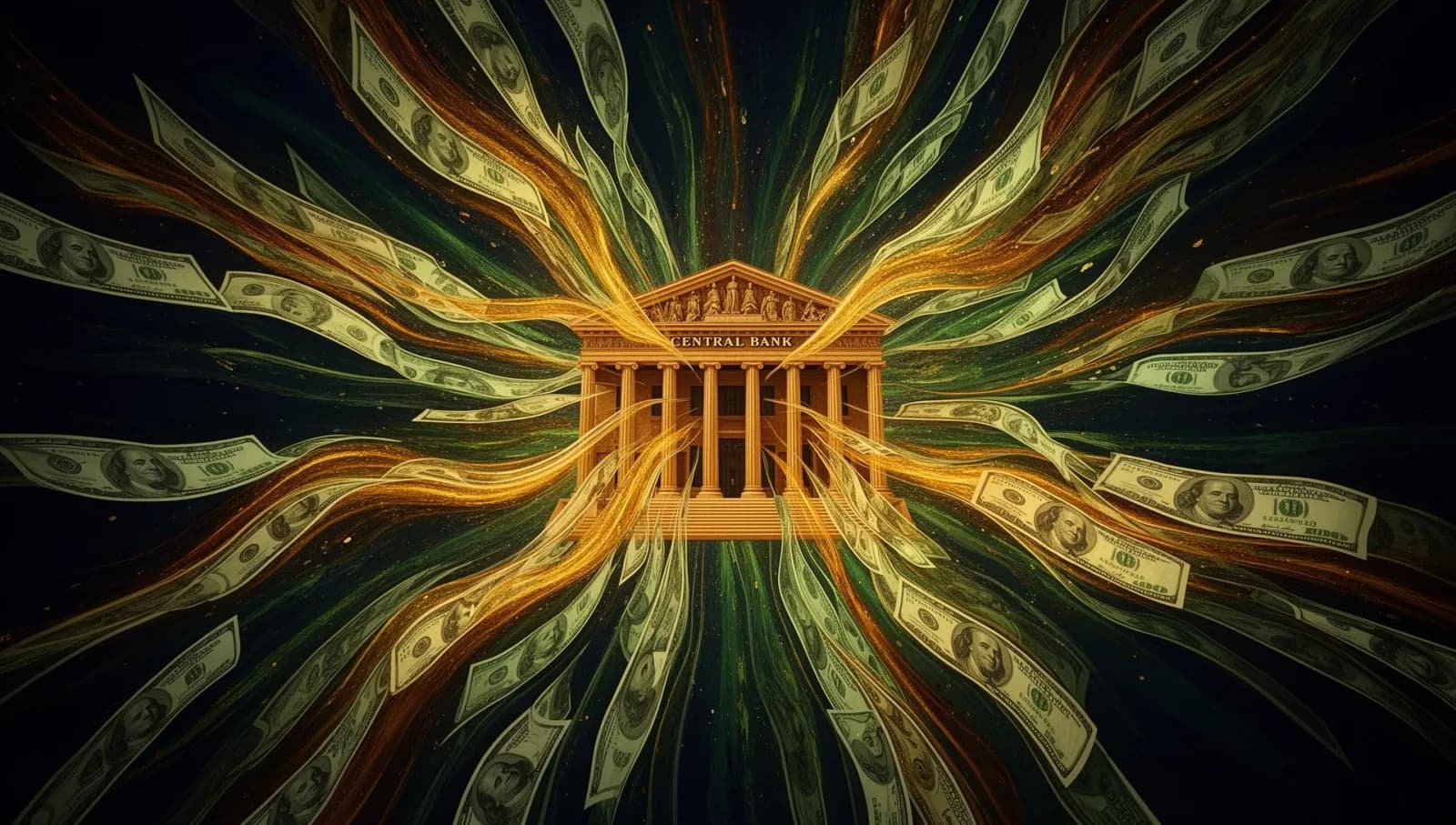
On the Centralization of Money Creation
If we wish to understand why the world feels increasingly unequal, unstable, and spiritually hollow, we must begin with an uncomfortable truth: money itself is not created equally. Behind the grand theater of economies and politics lies a mechanism so ordinary, so quietly accepted, that most people never question it — the centralization of money creation.
The modern financial system, through fractional reserve lending, allows private banks to generate the vast majority of the world’s money supply. More than ninety percent of the money in circulation does not exist as coins or paper bills printed by governments, but as digital entries on the balance sheets of banks — conjured into being the moment a loan is issued.
This system has given rise to the modern economic miracle — and to the crisis of inequality that shadows it. For when the privilege of money creation is concentrated in the hands of a few, wealth naturally accumulates at the top, and debt accumulates below. It is a machine that runs on the hopes of borrowers and the calculations of financiers — a system where money is born as debt, and debt demands payment with interest.
To grasp the consequences of this arrangement is to see the invisible architecture of the modern world — the hidden hierarchy upon which all others rest.
I. The Hidden Alchemy of Modern Money
At its core, fractional reserve lending is a kind of financial alchemy. A depositor entrusts their savings to a bank. The bank, instead of merely holding that money, lends most of it out to borrowers. Those borrowers then spend it, and the recipients deposit it in their own banks, which lend most of it out again — and the process continues.
From a small seed of real capital, a vast tree of credit grows. Each loan creates a deposit; each deposit becomes the basis for another loan. What began as $1,000 in savings might generate $10,000 or $20,000 in credit, depending on the reserve ratio. The result is that the money supply is not a fixed quantity determined by the government, but a fluid, expanding ocean determined by the lending behavior of banks.
In effect, banks create money out of promises — promises to repay, promises backed by collateral, promises underwritten by the faith that the economy will continue to grow. Money, in this sense, is not a tangible substance but a network of trust, or perhaps more accurately, a network of obligations.
The miracle of this system is that it allows for expansion, innovation, and growth. The danger is that it creates an economy perpetually dependent on debt — and on the institutions that control its creation.
II. The Birth of a Centralized Power
Before the rise of central banking, money creation was a decentralized affair. Goldsmiths, merchants, and regional banks issued notes backed by precious metals or commodities. The system was chaotic but relatively local — wealth creation was distributed across communities.
The 20th century changed that. With the establishment of central banks such as the Federal Reserve in 1913, the process of money creation became formalized and centralized. Governments ceded control of monetary issuance to a hybrid institution — part public, part private — tasked with maintaining stability and trust in the currency.
In theory, the central bank would serve the public good by ensuring full employment, stable prices, and economic growth. In practice, it became the axis of financial power, the unseen heart of the economy, regulating credit and setting the terms by which money enters circulation.
Commercial banks, in turn, became the satellites orbiting this central power. They borrowed from the central bank, created loans, and extended credit to the economy — always at interest. The system functioned beautifully as long as confidence was maintained. When confidence faltered, however, the entire house of cards trembled.
The crisis of 2008 made this painfully clear. The world discovered that the very institutions entrusted with stability were themselves the source of fragility. And yet, in the aftermath, they became even more powerful — bailed out by the governments that depended on them.
Money, it seemed, had become a closed loop — created by banks, lent to governments and corporations, and repaid with interest that could only be met by creating yet more debt.
III. The Cycle of Debt and Dependency
To understand inequality today, we must see how money is born as debt. Every dollar in existence was once a loan. When you take out a mortgage, the bank does not transfer existing funds — it creates new money in your account, backed by your promise to repay. The same is true for corporate loans, student loans, and even government bonds.
This means that every dollar comes into existence already owing a future dollar plus interest. But the money to pay that interest does not yet exist. It must be created by further lending. The system, therefore, requires perpetual expansion — more debt, more growth, more consumption.
The result is a treadmill economy. Growth becomes not a sign of prosperity, but a condition of survival. If lending slows, the money supply contracts, leading to recession. If it accelerates too quickly, inflation erodes purchasing power. Central banks walk a tightrope, attempting to balance these forces — but the fundamental structure remains unchanged: the economy depends on an ever-expanding mountain of debt.
The burden of this debt falls unevenly. Those who own assets — real estate, stocks, bonds — benefit from rising prices fueled by cheap credit. Those who live on wages find their earnings diluted by inflation and their debt burdens magnified by interest. Over decades, the result is what we now see: a massive transfer of wealth from labor to capital, from borrowers to lenders, from the many to the few.
IV. The Spiritual Consequence of Debt
Debt is not merely an economic instrument; it is a moral one. It binds people through obligation, through guilt, through the sense of having borrowed something they must repay. In older civilizations, debt was often associated with sin — the idea of owing something sacred, of having violated a cosmic balance.
In modern capitalism, this moral language has been disguised by mathematics. Debt is expressed in percentages and interest rates rather than guilt or penance. But the emotional structure remains. To be indebted is to live under pressure, to feel the weight of time turned against you. It is to wake each morning owing more than you possess — not only money, but peace of mind.
When an entire civilization is built on debt, its people live in a state of collective anxiety. The worker owes the bank. The bank owes the central bank. The government owes the bondholders. Everyone owes someone. No one feels truly free.
The consequence is a spiritual poverty that mirrors the economic one. People measure their worth by credit scores. They trade their future hours of labor for present comfort. They mistake liquidity for security. The few who control the flow of money become not merely wealthy but quasi-divine — creators of value ex nihilo, gods of modern finance.
V. The Mechanics of Inequality
The centralization of money creation is not just a technical feature of the banking system; it is the root mechanism of systemic inequality. Consider the following dynamic:
-
Banks create money by lending.
-
Those who already have collateral — property, businesses, stocks — can borrow more easily and cheaply.
-
Those without assets face higher rates or are excluded entirely.
-
-
Asset prices rise with increased lending.
-
The wealthy, who own assets, see their wealth multiply.
-
The poor, who own none, see the cost of entry soar.
-
-
Interest payments flow upward.
-
Borrowers pay interest to banks.
-
Banks distribute profits to shareholders and executives, who are disproportionately wealthy.
-
-
The cycle repeats.
-
The rich borrow to invest; the poor borrow to survive.
-
The system rewards financial leverage, not labor.
-
In such a system, inequality is not a glitch — it is the design. The financial elite sit at the point of origin, where money is created. Everyone else receives it downstream, already encumbered with interest.
VI. The State as a Servant of Finance
It is often assumed that governments control the economy. In reality, the economy controls governments, and the control mechanism is debt. States, like individuals, borrow from the very institutions they are meant to regulate. They issue bonds purchased by private banks, which in turn use those bonds as collateral for further lending.
When a government borrows, it pledges its future tax revenue — the labor of its citizens — as collateral. Thus, the people themselves become the ultimate guarantors of the banking system.
This creates a subtle inversion of democracy. The state, which was meant to represent the will of the people, becomes dependent on the confidence of financiers. Policies that might disrupt the financial order — debt forgiveness, monetary reform, wealth redistribution — are deemed “irresponsible.” Stability becomes the supreme virtue, even when that stability protects an unjust equilibrium.
The irony is that while governments are theoretically sovereign, their sovereignty is constrained by the same institutions they rescued during crises. The rescuer becomes the captive. The lender becomes the ruler.
VII. The Psychology of Acceptance
One might wonder why people tolerate such a system. Why do the many accept a world where the few can create money from nothing while others labor endlessly to earn it? The answer lies partly in belief. Money, after all, is faith institutionalized. It functions because we agree to believe in it.
But there is another reason — the illusion of opportunity. The system sustains itself by holding out the promise that anyone can rise, that hard work and talent will be rewarded. The few who actually do rise — the tech founder, the real estate mogul, the hedge fund manager — become symbols of this possibility. Their success stories obscure the structural barriers that prevent most from following.
This is the same psychology that keeps gamblers returning to casinos. The odds are against them, but the rare winner sustains the dream. So it is with capitalism’s financial order. A few strike it rich; the rest fund the game.
VIII. The Moral Blindness of Technocracy
The defenders of the current system argue that centralization is necessary — that without centralized control of money creation, chaos would reign. They invoke the specter of inflation, corruption, and instability. And to a degree, they are right. Money is a delicate thing; too much freedom in its creation can destroy its value.
Yet what they ignore is that the concentration of this power produces its own kind of corruption — a more subtle one. When the right to create money is granted to a small class of technocrats and financiers, the moral question of “who deserves what” is replaced by the technical question of “what sustains growth.”
The human element — justice, fairness, dignity — is excluded from the equation. People become data points in a balance sheet. Nations become “markets.” Crises become “corrections.” The language of morality is replaced by the language of efficiency.
But efficiency without justice is cruelty in disguise. And a system that optimizes for profit while externalizing suffering will, in time, collapse under its own contradictions.
IX. Alternatives and Revolutions
Throughout history, societies have experimented with other models of money creation. Some ancient cultures used public credit systems, where the issuance of money was directly tied to communal projects. Medieval guilds issued mutual credit, where money was created not by debt but by exchange. Even in the modern era, proposals for sovereign money systems — where the state, not private banks, issues currency directly — have resurfaced.
The rise of cryptocurrencies represents another kind of rebellion: the attempt to decentralize money creation entirely. Bitcoin, for instance, was born from distrust in centralized banking after the 2008 crisis. Its promise was radical transparency and mathematical scarcity — money without masters.
Yet even here, the paradox remains. New systems quickly reproduce old hierarchies. Wealth concentrates in early adopters, and speculation replaces use. The dream of financial liberation becomes another market of greed.
The challenge, then, is not merely to decentralize money technically, but morally — to create a system where the creation of value serves humanity rather than exploits it.
X. The Path Forward: Toward a Just Economy
To envision a more just economic order, we must begin by reclaiming the moral dimension of money. Money should not be a tool of domination but a medium of cooperation. It should reflect not the privilege of creation, but the participation in creation — the shared work of building a society.
Practical steps could include:
-
Public banking: Institutions owned by communities, lending for productive rather than speculative purposes.
-
Universal basic services: Reducing dependency on debt by guaranteeing essentials like healthcare, housing, and education.
-
Progressive monetary reform: Gradually shifting the power of money creation from private banks to public institutions accountable to citizens.
-
Financial education: Teaching people not just how to make money, but how money is made.
But reform is not enough if it does not address the deeper spiritual imbalance — the belief that money is the ultimate measure of worth. As long as wealth is confused with value, and credit with virtue, we will remain trapped in the same cycle, merely rearranging the seats on the deck of the ship.
XI. The Philosophical Reckoning
At its deepest level, the centralization of money creation is a question of power and trust. Who do we trust to create value? Who decides what the future is worth? In earlier times, these questions were theological; now they are financial.
To say that banks create money is, in a sense, to say that they create reality. For in a world governed by credit, what is funded becomes real, and what is unfunded remains imaginary. The artist, the scientist, the teacher, the farmer — all depend on the gatekeepers of credit to turn potential into existence.
Thus, the concentration of money creation is also the concentration of imagination. The power to decide which dreams come true belongs to those who control capital. And so, the world becomes the image of their desires — a world of profit without purpose, growth without meaning, and wealth without wisdom.
XII. Conclusion: The Question of Value
To question the centralization of money creation is to question the foundation of modern civilization. It is to ask: What is value? Who should define it?
If value is merely what can be priced, then the current system makes sense. But if value includes justice, beauty, community, and love — if value is the flourishing of life itself — then our monetary architecture is profoundly misaligned.
A sustainable and humane economy would treat money not as a commodity but as a public utility, a shared medium through which society expresses its collective priorities. Until that day, we will remain in a world where money multiplies faster than meaning, and where the miracle of creation has been privatized.
The story of modern finance is, at heart, a spiritual story: the replacement of faith in God with faith in credit. The central banks are our new temples, and the money supply their sacrament.
To reclaim our humanity, we must remember that money is not the source of value — we are. Value arises from creativity, labor, cooperation, and love. Money should serve those ends, not define them.
The centralization of money creation has given us abundance in numbers and scarcity in spirit. The next evolution of civilization will require us to reverse that equation — to create an economy where money once again serves life, and not the other way around.