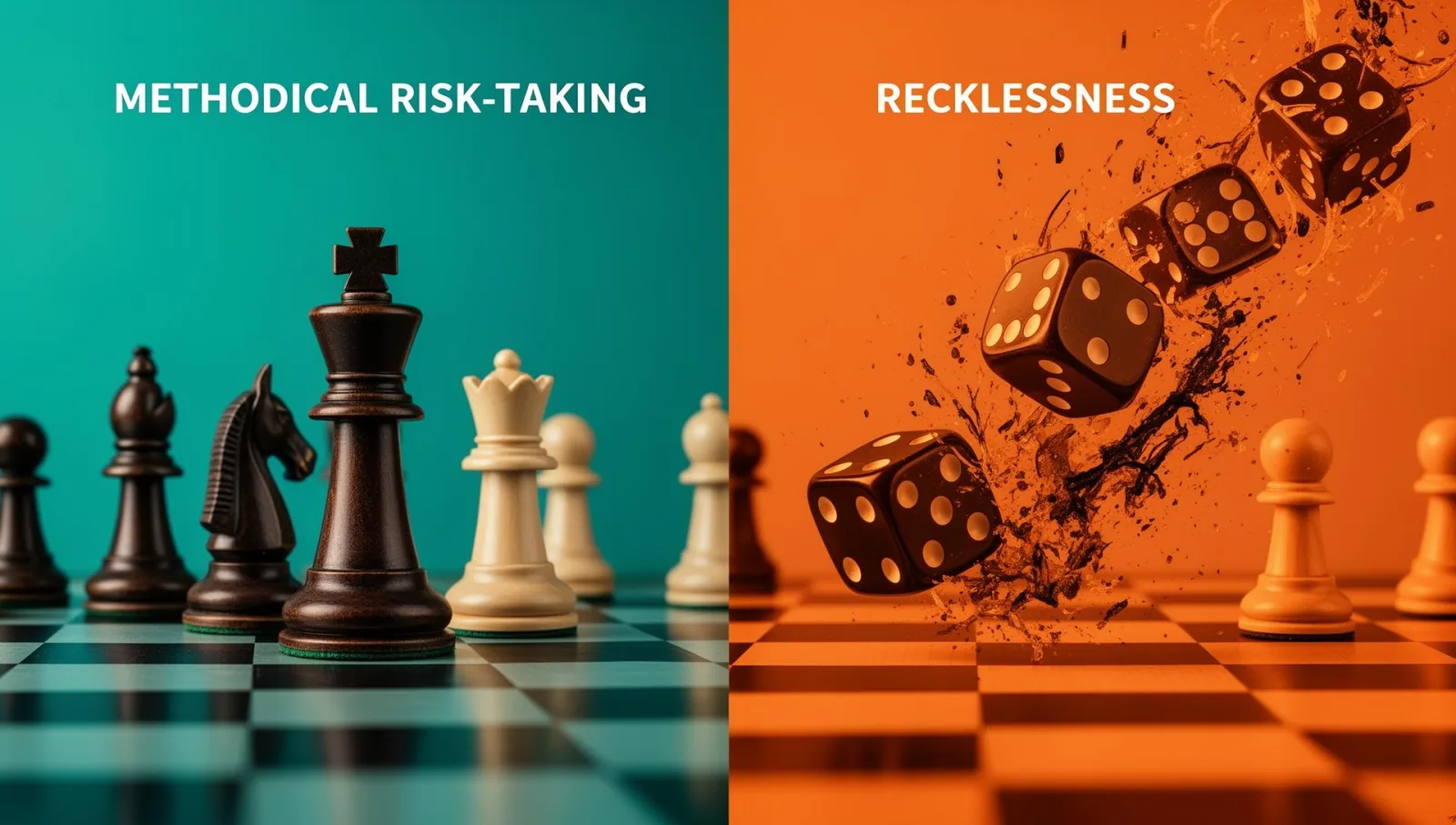
Understanding the Difference Between Deliberate and Methodical Risk-Taking — and Recklessness
In every field that rewards ambition — business, art, love, or adventure — risk is the inevitable toll for progress. Nothing worthwhile comes entirely without uncertainty. But not all risks are created equal. Some risks are deliberate and methodical, calculated with precision and guided by awareness. Others are reckless — impulsive, blind, and destructive. The difference between the two can determine whether a person ascends toward mastery or collapses under the weight of their own overconfidence.
To live without risk is to stagnate. To live recklessly is to self-destruct. The art of life and enterprise lies in finding the middle path — where you take bold, intentional risks with controlled exposure, where the potential upside justifies the gamble, and where failure, if it comes, does not destroy you.
I. The Psychology of Risk
Risk is often romanticized. Movies glorify the entrepreneur who bets everything and wins, the artist who burns bridges for a vision, the gambler who pushes all-in and hits the jackpot. These images distort reality. They conflate bravery with recklessness and intuition with impulse.
Real risk-taking begins not with the thrill of danger, but with an understanding of probability. It is the act of standing in front of the unknown with awareness of both what you might gain and what you might lose — and deciding that the former outweighs the latter.
Recklessness, by contrast, begins where awareness ends. It’s acting without proper understanding, preparation, or respect for consequences. It’s mistaking chaos for courage.
The disciplined risk-taker asks, What can go wrong, and how do I survive if it does? The reckless one says, Let’s see what happens.
II. The Business Arena: Risk as a Calculated Art
Business, more than almost any other discipline, requires comfort with uncertainty. Markets shift, competitors adapt, and technology evolves faster than plans can be written. To an outsider, the world of startups or investing may look like a casino. But the successful players are not gamblers — they are statisticians with intuition, psychologists with data, and generals with patience.
To survive in business, you must accept that every decision involves some risk. But that acceptance is not a license for recklessness. In fact, the best entrepreneurs are almost obsessive about reducing risk wherever possible. Their job is not to chase danger but to build safety nets — through research, diversification, timing, and systems that prevent catastrophic loss.
The misconception that great business is partly reckless stems from the illusion of confidence. When we see an entrepreneur make a bold move, we assume it was spontaneous. In reality, most bold moves are the result of weeks or years of preparation. What looks like a leap of faith is often a carefully measured jump with a safety harness already in place.
III. The Cost of Rushing
Impatience is one of the hidden forms of recklessness. In business and in life, the temptation to rush can be devastating. When people are anxious for progress, they mistake speed for success.
A decision rushed by a day can cost weeks. A decision rushed by a week can cost months or even years. Every premature action plants seeds of disorder that you will later have to clean up — often at a far higher cost than if you had simply waited to act when the moment was right.
Deliberate risk-taking means knowing when not to act. It means having the discipline to hold back, to gather information, to let conditions ripen before committing resources. The reckless mind confuses movement with progress. The deliberate mind understands that patience is the hidden engine of power.
IV. The Mathematics of Smart Risk
To take intelligent risks, you must learn to think like an investor, even if you’re not one. In the simplest form, every risk has two variables: probability and impact.
-
Probability is the likelihood that something will happen.
-
Impact is how much it will matter if it does.
Reckless people ignore one or both of these variables. They assume success without measuring likelihood or assume failure will be tolerable without understanding the cost.
The disciplined risk-taker maps both dimensions. A smart risk might have a 30% chance of success but a 10x potential return — making it statistically worthwhile. A foolish risk might have a 70% chance of success but catastrophic downside — making it fatal when it fails.
In this way, good risk is not about being brave. It’s about understanding odds. You take a small, survivable risk for a disproportionately large potential gain. You never take a large, life-threatening risk for a small, temporary reward.
V. The Myth of “High Risk, High Reward”
One of the most dangerous myths in modern culture is the phrase “high risk, high reward.” It sounds motivational, but it’s statistically false. High risk usually means high loss.
Real success comes from low risk, high reward. That’s the magic ratio every seasoned entrepreneur and investor hunts for — opportunities where the potential upside vastly outweighs the downside. This requires creativity, insight, and patience, not recklessness.
The most successful people in any field do not take the biggest risks; they take the smartest ones. They build asymmetric bets — scenarios where losing costs little and winning changes everything.
Think of Elon Musk’s Tesla. From the outside, it looked like madness: an electric car company in an industry dominated by century-old automakers. But beneath the surface, the risk was calculated. Musk already had capital from PayPal, access to top engineers, and an emerging market wave toward sustainability. He was not gambling in the dark. He was surfing a tide he could see coming.
Contrast that with a college student with no technical experience deciding to “start the next Tesla.” The odds are astronomically different. That’s not ambition — that’s delusion. The scale of the idea is the same, but the preparation, network, and resources are not.
The difference is not the size of the dream — it’s the depth of the foundation.
VI. Recklessness Disguised as Courage
Recklessness often hides behind the mask of bravery. People call it “boldness,” “vision,” or “faith.” But courage is not the absence of fear — it is action despite fear, guided by knowledge. Recklessness is action without knowledge, guided by ego.
In entrepreneurship, reckless people often overestimate themselves and underestimate complexity. They rush into industries they don’t understand, spend money they haven’t earned, and assume success will come through sheer willpower.
This mindset may look glamorous for a moment — the hustler spirit, the underdog energy — but in time it collapses. Systems built on adrenaline cannot outlast systems built on structure.
Recklessness may produce short-term excitement, but it destroys long-term trust. Investors, employees, and partners learn quickly who makes emotional decisions and who makes rational ones. Once you earn a reputation for recklessness, it’s hard to recover credibility.
Being deliberate, in contrast, builds quiet confidence. You may move slower at first, but when you strike, the impact is precise.
VII. The Surfer Analogy
Imagine a beginner surfer paddling out to one of the world’s most dangerous breaks — Mavericks in Northern California. The waves are 60 feet high, the water cold, the rocks sharp.
He paddles out with a foam board and no safety vest because he “believes in himself.” To a professional, this isn’t courage. It’s suicide. The beginner might survive one wave by luck, but the odds of disaster are near certain.
Venture capitalists see reckless entrepreneurs the same way. They’ve watched hundreds of people paddle into waves they cannot handle. A few survive by miracle, but most are crushed. Investors don’t admire that kind of courage — they avoid it.
They prefer the surfer who has trained for years, who knows the tides and the wind, who brings a team, a jet ski, and rescue support. That’s a calculated risk. The danger is still real, but it is managed.
In both surfing and business, preparation transforms recklessness into mastery.
VIII. The Microcosm of Everyday Life
The distinction between deliberate risk and recklessness applies beyond business. It’s woven through daily life — in health, relationships, and even recreation.
Take the example of drug use at a concert. Taking five tabs of acid while drinking heavily might sound “adventurous,” but it’s almost guaranteed to end badly. You’re not exploring consciousness — you’re gambling with it.
A more deliberate approach — say, taking a half tab, having a single drink, and gauging your response before adjusting — might still involve risk, but it’s methodical. You remain self-aware and in control. You manage variables rather than surrender to them.
The same principle applies to relationships. Jumping headfirst into a commitment with someone you barely know is reckless. Taking time to understand their values, temperament, and long-term goals is deliberate.
Even in fitness: lifting weights far beyond your capacity is reckless; progressively increasing load over time is calculated. The pattern holds across all domains — good risk empowers, bad risk injures.
IX. The Ego Trap
Recklessness often arises from ego — the desire to prove something to others or to oneself. When people act from insecurity, they seek validation through grand gestures. They want to be seen as fearless, decisive, or visionary. But ego-driven risks are rarely about the objective reward. They’re about the story.
Deliberate risk-takers are motivated by results, not recognition. They don’t need to impress anyone. Their focus is on the system — the process, the numbers, the feedback.
Ego says, “I’ll show them I can do it.” Wisdom says, “I’ll learn what it takes to do it right.”
The difference in outcome is vast. Ego burns fast and ends badly. Wisdom endures and compounds.
X. The Discipline of Small Experiments
One hallmark of deliberate risk-taking is the use of experiments. Before betting the farm, smart operators test ideas on small scales. They collect data, learn from feedback, and iterate.
Reckless people skip this phase. They assume they know the answer. They take one giant swing instead of a hundred small ones.
In truth, all great innovation is built on micro-risk. Amazon tested countless product categories before becoming “the everything store.” SpaceX ran hundreds of simulations before every launch. Even the best poker players fold most of their hands — they wait for odds worth playing.
Deliberate risk-taking is not about taking one massive leap; it’s about taking many manageable steps with increasing confidence.
Each step expands your circle of competence — the zone in which you can safely take larger bets. Reckless people never build that foundation. They stay perpetually out of their depth.
XI. Emotional Regulation: The Inner Game of Risk
The difference between methodical and reckless risk-taking often comes down to emotional regulation. Fear, excitement, and greed can all distort decision-making.
A reckless person acts in the emotion. They buy stocks because everyone else is buying, they start businesses out of envy, they pivot out of panic.
A deliberate person acts despite the emotion. They feel the same fear or excitement, but they wait until the numbers, timing, and intuition align.
The best decision-makers cultivate a sense of inner stillness. They know that big opportunities will test their patience — and that emotional reactivity is the enemy of sound judgment.
As Warren Buffett put it, “The stock market is a device for transferring money from the impatient to the patient.” The same applies to every form of risk in life.
XII. Building a System That Absorbs Loss
Even the most calculated risks will sometimes fail. The difference is that deliberate people design systems that can absorb those failures.
They diversify their efforts, keep cash reserves, maintain relationships, and avoid single points of failure. When one project collapses, it doesn’t destroy their foundation.
Reckless people build everything on one bet. When it falls, everything falls.
A smart risk-taker prepares for loss as much as for gain. They ask, If this goes wrong, can I survive? If the answer is no, the risk is too high — no matter how tempting the reward.
This principle isn’t pessimism; it’s respect for reality. It’s understanding that longevity is the true mark of success.
XIII. Patience, Process, and the Long Game
Deliberate risk-taking favors the long game. It’s about compounding results over time — not winning everything at once.
Reckless behavior, by contrast, is rooted in impatience. It seeks immediate validation and instant results. But time has a way of exposing shortcuts.
The deliberate risk-taker invests years mastering fundamentals, building relationships, and refining processes. Their growth may seem slow, but it is exponential. Each decision strengthens the next.
Eventually, they appear “lucky” — but their luck is the result of hundreds of small, smart risks compounded into expertise.
XIV. The Paradox of Control
There’s a final paradox to consider: you can only control risk by accepting that you don’t control everything.
The reckless person tries to dominate chance through force — they overinvest, overcommit, overpromise. The deliberate person cooperates with uncertainty — they manage exposure, hedge bets, and adapt when reality shifts.
True mastery of risk means acknowledging limits. You cannot eliminate uncertainty, but you can design your life and business to remain intact within it.
That humility — the acceptance of uncertainty — is what transforms courage into wisdom.
XV. Conclusion: The Quiet Power of Deliberation
The world celebrates boldness, but it rarely celebrates restraint. Yet it is restraint — the discipline to think before acting, to study before leaping — that separates the visionary from the reckless.
Deliberate, methodical risk-taking is not about fear; it is about focus. It is the art of channeling energy, knowledge, and timing into actions that move you forward without destroying your base.
Recklessness may look glamorous for a moment, but it burns fast. Deliberation endures. It builds wealth, reputation, and peace of mind.
The real game of life is not to find the biggest risk, but to find the smartest one — the bet where you risk little, learn much, and build momentum with every move.
In business, relationships, and personal growth, the principle holds true:
Big reward is big reward. Your job is to find how to achieve it with the smallest risk possible.That is not cowardice — it is mastery. And in the long run, mastery always wins.